
Patient guide
Absolute vs. Relative Risk in Embryo Reports

Reticular Team
Patient Education

A risk number can feel official. It has decimals, a percentile, a color-coded chart. But before it can mean anything to you, you have to ask one question: what kind of number is it?
Embryo reports use three different kinds, and they are easy to confuse when you are tired, hopeful, and trying to decide quickly. This page is a short glossary. We define each term the same way, then show you how common report phrases can mislead you, and how to translate them back into plain language.
The three terms are absolute risk, relative risk, and relative inherited risk. Here is each one, defined the same way: what it asks, a plain example, and the trap to watch for.
Term 1 — Absolute risk
What it asks: What is the estimated chance this outcome actually happens, over a defined stretch of time?
A plain example: "Estimated lifetime risk: 8 in 100." That is a stand-alone number. It does not need a second group to make sense — it is the chance on its own.
The trap: absolute risk is the version most people actually want, and the version reports often bury. The National Cancer Institute notes that absolute risk is often more useful than relative risk for clinical and public-health decisions. In embryo reports it is what keeps a large-sounding relative difference in perspective, especially for conditions that are uncommon to begin with.
Term 2 — Relative risk
What it asks: How does one risk compare with another? It is a ratio, not a chance.
A plain example: if one estimate is 10 in 100 and another is 5 in 100, the first is "twice as high" — or the second is "50% lower." Both describe the same comparison. The CDC epidemiology training materials define this risk ratio, also called relative risk, as comparing the risk of a health event in one group with the risk in another.
The trap: a relative number sounds dramatic but hides where you started. "50% lower" can mean almost nothing or quite a lot, depending entirely on the baseline. That is the most important thing to remember on this page, so it has its own section below.
Term 3 — Relative inherited risk
What it asks: How does this embryo's inherited genetic risk estimate compare with its sibling embryos, or with a reference group?
A plain example: "Embryo A has a lower relative inherited risk estimate for this condition than Embryo B." Embryos from the same parents share most of their family background, but each inherited a different mix of parental DNA. A polygenic score — a single number that adds up many small genetic markers — estimates whether one embryo's inherited mix looks higher or lower risk than another's.
The trap: this is a ranking, not a verdict. A lower estimate for Embryo A does not mean Embryo A will avoid the condition, and a higher estimate for Embryo B does not mean Embryo B will develop it. The model ranked their inherited estimates differently for one named condition — nothing more.
Other kinds of risk you may meet
Two more words show up next to a risk number, and they change what it means. Lifetime risk is the chance an outcome happens at some point over a whole life. Risk by a certain age, or over the next so many years, is the chance within a shorter window. The same condition can look very different depending on which window the number describes — a small chance by age 50 can be a much larger chance over a full lifetime.
So before you compare two numbers, check that they cover the same stretch of time. The National Cancer Institute notes that absolute risk is usually given for a defined period, and a lifetime estimate and a by-a-certain-age estimate are not interchangeable. If a report does not say which one it is using, that is a fair thing to ask.
It also helps to place a polygenic embryo number in this picture. It is a relative inherited risk estimate — how this embryo's inherited markers compare with its sibling embryos or a reference group. It is not a personal lifetime guarantee, and it is not the same as a lifetime or by-a-certain-age chance for a future child.
One more distinction sits underneath all of these. A report's "X in 100" is almost always a population estimate — the average for people who share certain genetic markers — not a personal certainty for one future child. Your own number can land higher or lower depending on family history, environment, and chance, none of which a polygenic score fully captures. So a population figure is a starting point for a conversation, not a forecast for an individual.
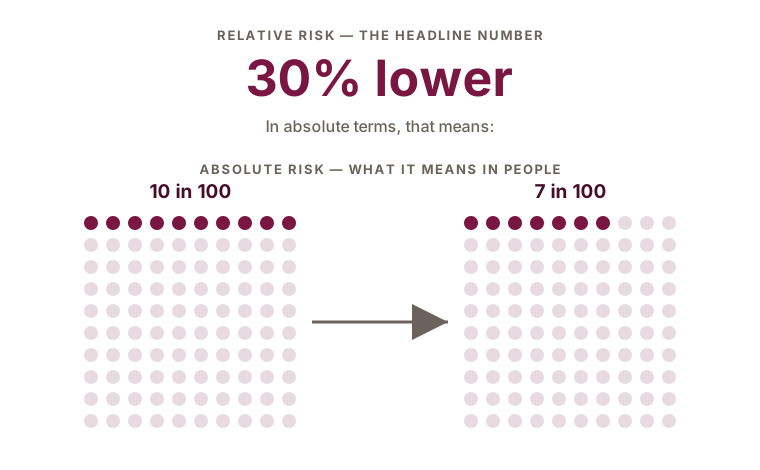
Keep the picture above in mind. The headline is a percentage, but what it means is how many real people out of 100 — the number the dots show. That gap between the headline and the dots is where most confusion comes from.
The same phrase, two very different meanings
Here is why a relative number alone can mislead you. Both rows below are described with the exact same words — "50% lower" — yet they mean wildly different things in real life.
| Change | Relative wording | Absolute difference |
|---|---|---|
| 2 in 1,000 to 1 in 1,000 | 50% lower | 1 in 1,000 |
| 40 in 100 to 20 in 100 | 50% lower | 20 in 100 |
Same relative phrase, very different practical meaning. One changes the risk by a single person in a thousand. The other changes it by one person in five. That is why a patient-facing report should always show absolute risk beside the relative wording whenever the model can support it. If a number sounds big, the most useful thing you can ask for is the starting risk. A relative change is far easier to read when the plain-number difference sits next to it.
What common report phrases really mean
Reports rarely say anything false. They say things that are technically accurate and easy to over-read. The table below takes common phrasings and splits each one into a careful reading and a reading to avoid. When you get your own report, you can run its sentences through the same two columns.
| Report phrase | A careful reading | Do not read it as |
|---|---|---|
| Estimated lifetime risk: 6 in 100 | A modeled absolute risk estimate for a defined outcome. | A diagnosis or certainty about a future child. |
| 40% lower than another embryo | A relative comparison between two modeled estimates. | A 40 percentage-point drop in absolute risk. |
| Lower relative inherited risk | The embryo inherited a genetic pattern estimated to be lower-risk for that condition within the comparison set. | Certainty about transfer, pregnancy, live birth, or long-term health. |
| In the lowest-risk category | A percentile or band relative to a reference group — a rank, not a chance. | A low absolute chance; the band can still sit on a high baseline. |
| Top embryo / best embryo | Lowest modeled estimate for one named condition in this set. | The most clinically suitable embryo to transfer overall. |
Two patterns run through every row. First, a rank ("lowest category," "top embryo") is never the same as a chance — it tells you where an embryo sits in a lineup, not how likely the outcome is. Second, an estimate about one condition is never a statement about a whole future child.
Two habits that keep you from being misled
Risk-communication research is consistent on one point: format changes how well people understand the same number. The CDC recommends pairing numeric probabilities with words or visuals and notes that natural frequencies — plain counts like "1 in 4" — are often easier to grasp than percentages. A BMJ explainer on relative and absolute risk reduction makes the same case from the other side: a relative reduction should never be read without its baseline risk.
So when a number lands in front of you, two habits do most of the work. Ask for the "out of 100" version. "7 out of 100" is usually easier to sit with than "30% lower," and translating one into the other is a fair thing to request. And ask for the starting number behind any relative claim — without the baseline, "50% lower" doesn't tell you how much the risk actually changed. It is also reasonable to ask what baseline the model used, whether the estimate is lifetime or by a certain age, whether the score was calibrated for your ancestry and family context, how much uncertainty surrounds it, and how it should be weighed against PGT-A, PGT-M, embryo morphology, age, and clinical history.
Why this care matters for PGT-P specifically
All of this matters more for polygenic screening than for almost any other number you will see. The ASRM 2026 PGT-P opinion describes the technology as nascent and unproven and not recommended for clinical use. That caution is partly about model accuracy and partly about clinical utility: even when a model estimates inherited genetic risk, it has not been shown that using that estimate to prioritize embryos improves a child's health.
So it is worth reading any of these numbers carefully. A PGT-P number is an estimate, not a verdict. It is one possible input into a counseling conversation, never a substitute for medical judgment, and never certainty about a future child.