
Patient guide
Family History Before Embryo Screening: What to Gather and Why It Matters

Reticular Team
Patient Education

Family history is not a test you pass or fail. It is a set of clues, and this guide is about how to collect them, so your care team has something concrete to work from before embryo screening.
Sometimes those clues point toward targeted parent testing. Sometimes they show that a broad risk estimate is not the right first question. Often, they simply help your clinician or genetic counselor explain what a report can and cannot tell you. None of that works without the details themselves, so the rest of this guide covers what to gather: what to map, what to write down, what to do when the record is thin, which patterns to flag, and exactly what to say.
Build a three-generation family tree
The CDC recommends collecting family health history across close relatives when possible: parents, siblings, children, grandparents, aunts, uncles, nieces, nephews, and half-siblings. Three generations is the target because that span is usually enough to reveal an inherited pattern without becoming a research project. You do not need a perfect tree — bring what you know, mark what you are unsure about, and update it over time.
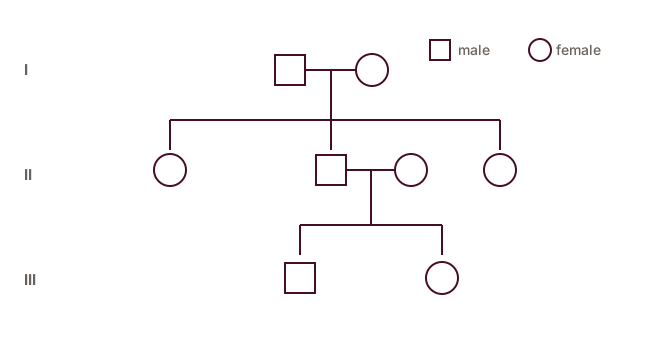
Write down these details for each relative
A name and a vague label do not give your counselor much to act on. For each relative who had something worth noting, try to capture four concrete fields. They are what turn a story into a usable clue:
Who and which side
Which relative had the condition, and whether they are on the egg provider's side, sperm provider's side, or both.
Exact diagnosis, if known
"Colon cancer at 42" is more useful than "cancer." "High LDL since childhood" is more useful than "heart problems."
Age at diagnosis
Earlier-than-usual disease can change whether genetics, cardiology, oncology, or another specialist should be involved.
Any genetic test report
If a relative is comfortable sharing it, the actual lab report is far more helpful than a family memory of "a gene was found."
Beyond those four fields, it can help to write down ancestry background, pregnancy losses, stillbirths, infant deaths, congenital differences, or developmental diagnoses if relatives are comfortable sharing that information. If a topic feels sensitive, it is okay to leave it blank and tell your counselor you are not sure.
What to do when you have gaps
Many people do not have a neat three-generation family tree. Families may be private, estranged, adopted, donor-conceived, blended, or simply unsure about exact diagnoses. That does not make the history useless — a labeled gap is itself information your counselor can use.
So write down what you know and label what you do not. "Maternal aunt, cancer in her 40s, type unknown" is still a clue. So is "limited information about sperm donor history" or "relative had genetic testing, report not available." Labeling what you do not know is useful too: a quiet or thin family history does not mean risk is zero, because families share genes, environments, access to care, and sometimes just incomplete information. A genetic counselor can often help decide whether a given gap changes the next step or not.
Patterns worth flagging
Once the snapshot exists, scan it for a handful of patterns. None of these mean something bad will happen. They are simply good reasons to ask whether genetic counseling, medical screening, or targeted testing should happen before embryo results are interpreted. Mark any that you see:
- A known disease-causing variant in a relative, such as a BRCA1, BRCA2, Lynch syndrome, cystic fibrosis, Huntington disease, cardiomyopathy, or rhythm-condition variant.
- Multiple relatives with the same or related cancers, especially breast, ovarian, pancreatic, colorectal, endometrial, metastatic prostate, or male breast cancer.
- Cancer, heart disease, stroke, very high cholesterol, or sudden cardiac death at young ages.
- A child or relative with a serious childhood-onset condition, intellectual disability, unexplained developmental delay, or congenital anomaly.
- A pattern that appears on one side of the family across several generations.
The two patterns below show how this reads in practice — one from cancer history, one from heart history. They are worth walking through because they show why the details you wrote down do so much work.
Worked pattern: hereditary breast and ovarian cancer (BRCA)
Say your snapshot shows an aunt with breast cancer at 41 and a grandmother with ovarian cancer, both on the same side. A family history of breast or ovarian cancer can mean many different things — some families have an inherited cancer syndrome, and many do not — but the clustering, the young age, and the same-side pattern are exactly the details that make a counselor look closer.
The CDC notes that hereditary breast and ovarian cancers can be caused by genetic changes passed down in families, including BRCA gene mutations. The National Cancer Institute's BRCA fact sheet explains that harmful BRCA1 or BRCA2 changes can substantially raise risks for breast, ovarian, and some other cancers, that they are inherited in an autosomal dominant pattern so each child of a carrier has a 50 percent chance of inheriting the variant, and that a positive result still does not determine whether or when cancer will occur.
If a relative has a known BRCA variant, the next useful step is usually targeted counseling and testing for the genetic parent, not guessing from a broad embryo risk estimate. If a parent turns out to carry a pathogenic variant, the care team can discuss whether PGT-M is relevant, what its limits are, and what confirmatory testing may be recommended later. This is the case where one captured lab report — the actual relative's result — can change the entire plan.
Worked pattern: early heart disease and familial hypercholesterolemia
Now say your snapshot shows a father who had a heart attack at 45 and a grandfather with very high cholesterol from a young age. Heart disease is common, so one older relative with heart disease does not point anywhere in particular. Timing and pattern are what make this specific: early onset, very high LDL ("bad" cholesterol), and the trait showing up across generations.
The CDC explains that family history can increase heart disease risk, and that relatives with heart disease at age 50 or younger can sometimes be a sign of familial hypercholesterolemia — a genetic condition that causes high cholesterol from early in life and has effective medical management. It is not rare: MedlinePlus reports it affects an estimated 1 in 200 to 1 in 250 people in most countries and follows an autosomal dominant pattern, meaning a single altered gene copy is enough and each child of an affected parent has a 50 percent chance of inheriting it.
For families with early heart attacks, very high LDL cholesterol, sudden unexplained death, or known cardiomyopathy or rhythm-condition variants, a genetic counselor may suggest parent testing, lipid screening, cardiology evaluation, or targeted embryo testing depending on the situation. The point of capturing the age and the cholesterol detail is that it can move the conversation toward care a parent benefits from now, not only toward embryo testing.
Match each pattern to the right next conversation
Family history mostly helps your team decide which question is actually on the table. Once your snapshot is marked up, this is how the common patterns tend to route:
| If the family history suggests... | The conversation may be... |
|---|---|
| A known single-gene condition or pathogenic variant | Should a genetic parent have targeted testing, and is PGT-M relevant? |
| A common, multifactorial condition | Would a risk estimate add useful context, and what would it miss? |
| A pattern that may affect adult health for a parent | Should medical screening or specialist care happen regardless of embryo testing? |
| Embryo risk estimates that are close together | Do clinical factors and family priorities matter more than the ranking? |
Four common mistakes to avoid
- Do not assume a condition only matters if it is on the mother's side. Many inherited risks can come from either genetic parent.
- Do not assume one negative direct-to-consumer result rules out a familial risk. Some tests cover only selected variants.
- Do not assume embryo screening removes the need for adult prevention, routine care, medication, or screening.
- Do not pressure relatives for information. Ask respectfully, explain why you are asking, and accept boundaries.
Two things you can say
It comes down to two short things you can say. The first is for a relative, when you are gathering the details above. You do not need to explain every detail of your IVF plan to ask a useful question:
"We are putting together our family health history for fertility and genetics counseling. Do you remember the diagnosis and roughly what age it happened? And if anyone ever had genetic testing, would you be comfortable sharing the report?"
The second is for your clinic or genetic counselor, once your snapshot is in hand. It hands them the clues and asks them to route the patterns:
"Here are the conditions in our families, the ages they happened, the side they are on, and any genetic test results we know about. Which of these should change what we test in the parents, what we test in embryos, or how we interpret the report?"
That keeps the focus where it belongs: not on collecting every possible detail, but on turning the details you do have into careful next steps with your care team.