
Patient guide
How Many Embryos Do You Need for Polygenic Screening to Be Useful?

Reticular Team
Patient Education

Patients often ask this in a very understandable way: "How many embryos do we need for polygenic screening to be useful?"
It is one of the most common questions patients bring to the counseling room, and it is completely fair to ask. But the question hides an assumption — that somewhere there is a threshold, a number of embryos above which PGT-P "works." This page works through that assumption step by step: why there is no magic number, which embryos actually count, why the count changes the math, what a real worked example looks like, and a framework for thinking it through with your care team.
The counseling-room version
The honest answer is that no single embryo count switches PGT-P on. Its possible value depends on several things at once: how many embryos are available to compare, which condition is being scored, how accurate that score is, whether the score fits your family's ancestry, and what decision your care team is actually trying to make. Change any one of those and the answer changes.
It helps to keep one fact fixed underneath all of this. PGT-P provides a risk estimate — usually best understood as relative inherited risk among sibling embryos, meaning how one embryo's inherited genetic risk compares with its siblings'. It does not settle health, implantation, pregnancy, live birth, or future disease. The ASRM 2026 Ethics Committee opinion states that PGT-P is not recommended for clinical use at this time and should not be presented as proven to improve outcomes. More embryos can create more room for comparison; they cannot make an unproven tool proven.
First, count the embryos that are actually in the decision
Before counting, it matters which thing you are counting — because "embryo count" can mean several different numbers. Eggs retrieved, mature eggs, fertilized eggs, blastocysts, biopsied embryos, and embryos eligible for transfer are not the same figure. IVF naturally narrows at each step, so the number that started your cycle is rarely the number that ends up in the decision.
For PGT-P, the count that matters is the smallest one: the embryos still available for transfer consideration after the clinic has reviewed embryo development, PGT-A or PGT-M results when performed, and any medical constraints. That is the only group a risk report can actually compare — not the eggs retrieved, and not the embryos created.
Why embryo count changes the math
Embryos from the same parents do not all inherit the same genetic variants. With more embryos, there are more possible inherited combinations to compare — which can increase the chance that one embryo has a meaningfully lower modeled estimate for a specific condition than another.
But more embryos never guarantee a useful difference. Sometimes sibling embryos score about the same. Sometimes the embryo with the lower modeled risk for one condition carries a higher modeled risk for another. And sometimes the embryo that looks best on a polygenic score is not the most clinically suitable to transfer at all, once PGT-A, morphology, developmental timing, or other medical factors are weighed. That is why the question feels frustrating: more embryos may create more choices, but they never make the report tell you which embryo to transfer.
The modeling literature lands in the same place. In eLife, Lencz and colleagues modeled polygenic embryo screening and found that outcomes depend strongly on selection strategy, score accuracy, disease prevalence, parental risk, and the number of viable embryos. Their model suggested that simply excluding embryos above a high-risk cutoff usually produces minimal reductions, while choosing the embryo with the lowest score can produce larger modeled relative reductions when there are enough embryos to choose among. A Human Reproduction Update review gathers several approaches — liability-threshold modeling, simulated embryos from real genomes, and sibling analyses — and is most useful for the line it keeps drawing between modeled benefit and proven clinical utility. None of these studies names a magic number, because there isn't one.
Those two approaches have names worth knowing, because a report's choice between them changes what its numbers mean. High-risk exclusion only sets aside the single highest-scoring embryo and treats the rest as interchangeable; in the models, it usually moves risk very little. Lowest-risk prioritization instead ranks all the embryos and points to the one with the lowest modeled risk, which is where the larger modeled reductions come from when there are enough embryos to compare. Reticular's trait estimates use the lowest-risk approach — the same model family Lencz and colleagues analyzed — so the report compares siblings rather than just flagging one outlier.
Underneath both is a liability-threshold picture of common conditions: inherited risk is spread across the population roughly like a bell curve, and a condition tends to appear once someone's combined risk crosses a threshold. A higher polygenic score shifts an embryo's curve toward that threshold; a lower one shifts it away. It moves the odds — it does not set a fixed outcome — which is why these are probabilities, not diagnoses. If you want to see how the math behaves, an open-source calculator and its 2025 preprint let you vary embryo count, score accuracy, and baseline risk and watch the modeled reduction shrink or grow.
What modeling studies suggest
An example makes the math concrete. Picture five sibling embryos scored for type 1 diabetes. The model gives a range of estimated risk across the five — and, importantly, that whole range shifts depending on family history.
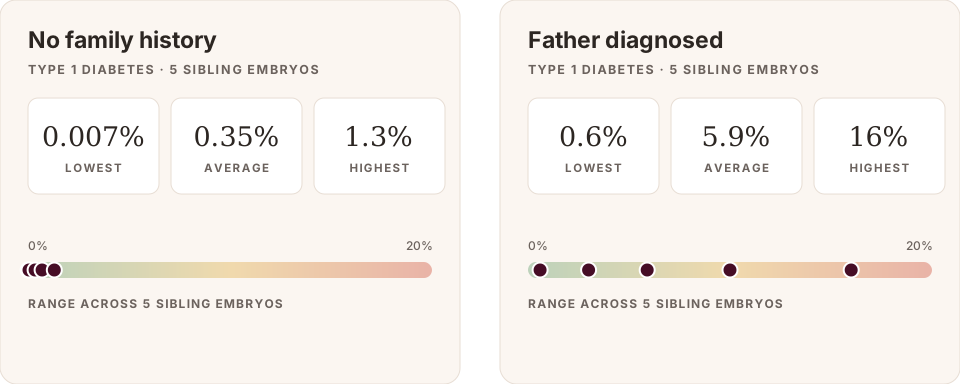
Two things decide how much that spread is worth. One is how many embryos you have to compare across — the count from Step 2. The other is how high the baseline sits to begin with. When the baseline is very low, even the highest-scoring embryo may still be low in absolute terms, so picking the lowest changes very little. When a parent is affected, the entire range shifts upward and the same comparison can carry real weight. Neither situation is a guarantee — they are modeled estimates, not measured outcomes — but they show why the same five embryos can mean different things for different families.
A practical way to think about embryo count
Putting Steps 2 and 3 together gives a rough way to think about how much PGT-P might add at different counts. Read the table below as a counseling framework, not a medical rule — it does not tell you what to do, and the "count" in the left column always means embryos available for transfer consideration after standard clinical review, never eggs retrieved or embryos created.
| Embryos available for transfer consideration | What PGT-P may add | Main caution |
|---|---|---|
| 1 embryo | Context about modeled inherited risk for that embryo. | There is no sibling embryo choice within that cycle. |
| 2 to 3 embryos | Some relative comparison may be possible for selected conditions. | Differences may be small, uncertain, or outweighed by clinical embryo-quality factors. |
| 4 to 6 embryos | More opportunity for modeled differences across one or more conditions. | A lower estimate for one condition may not align with lower estimates for others. |
| 7 or more embryos | The modeled chance of finding a lower-risk sibling embryo can increase. | The result is still model-based, and clinical utility remains unproven. |
Single-condition vs. multi-condition screening
Everything above assumes a single condition. The count question gets harder the moment a report scores several. An embryo may have a lower relative inherited risk estimate for coronary artery disease but a higher estimate for type 2 diabetes, or the reverse. Collapsing several conditions into one ranking requires value judgments — about severity, age of onset, preventability, family history, and your own priorities — that no model can make for you.
So reports should avoid simple "top choice" language. A more transparent phrase is "lower modeled inherited risk for the selected condition or index." If a report does combine conditions into one score, it should say plainly how each condition was weighted, and whether those weights were chosen by the lab, the clinician, or your family. With more embryos and more conditions, that question of who decided the weighting matters more, not less — and it is the part a higher embryo count can never resolve on its own.
What to ask your care team
A single sentence captures the whole framework, and it is a fair one to bring to your clinic: after the usual review, how many embryos are truly in the transfer-choice set — and are the PGT-P differences across that set large enough to matter? Alongside it, it is reasonable to ask whether the differences sit within expected uncertainty, whether the report shows absolute risk as well as relative inherited risk, and whether the score was validated for your ancestry and family context.
The bottom line
There is no embryo count that turns PGT-P into a proven tool. More embryos can create more room to compare modeled estimates, but the result is still a relative inherited risk estimate, and its clinical utility remains unproven. The useful question is not "how many embryos do we need," but how many are truly in your transfer-choice set, how large the differences across that set really are, and how that information should sit alongside your clinical care.