
Patient guide
Will Embryo Biopsy Hurt My Embryo?

Reticular Editorial Team
Patient Education

"Will it hurt my embryo?" sounds like one question. It is really two, and they have very different answers. One is about pain. The other is about whether biopsy changes the embryo's chance of becoming a pregnancy. Pulling them apart is the fastest way to feel less anxious about the procedure.
So this article does exactly that. It answers the pain question quickly, because the science there is settled. Then it spends most of its time on the second question, the viability one, because that is the part that genuinely depends on your embryo, your lab, and your reasons for testing.
There is no bad reason to ask either one. Many patients are holding two true things at once: wanting more information, and wanting to protect embryos they worked very hard to create.
Question one: can the embryo feel it?
This one has a short, reassuring answer. At the blastocyst stage, an embryo is a hollow ball of cells. It has no brain, no nerves, and no nervous system of any kind, so there is no biological machinery that could register pain. Pain requires a nervous system to sense and process it, and that simply does not exist yet at this point in development.
So when people picture biopsy as something the embryo "feels," that part can be set down. The diagram below shows why: at this stage the embryo is two simple groups of cells, with nothing in place that could experience a sensation.
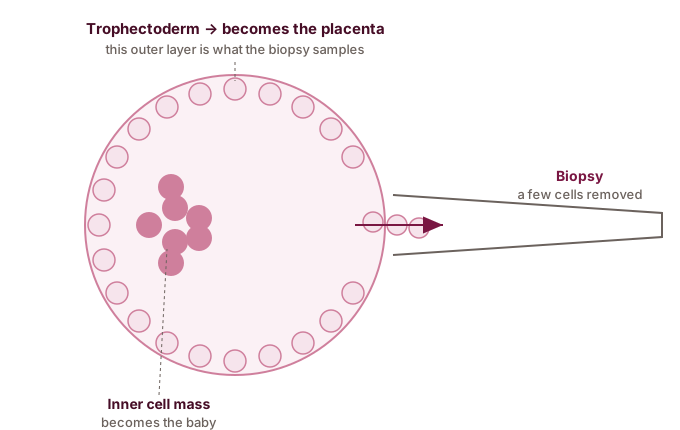
That same picture sets up the harder question. The biopsy samples the trophectoderm, the outer cell layer expected to contribute to the placenta, and tries to leave the inner cell mass, the group of cells expected to contribute to the fetus, untouched. ReproductiveFacts describes PGT biopsy as taking a small number of cells from the outer trophectoderm layer around the fifth or sixth day after fertilization (ReproductiveFacts patient education). So even though no part of the embryo can feel the procedure, cells are still being removed, which is exactly what the second question is about.
Question two: can it change the chance of a pregnancy?
This is the real question, and it deserves an honest, two-sided answer rather than a slogan. In many current PGT workflows, biopsy happens at the blastocyst stage, often around day 5, 6, or 7 after fertilization. ESHRE's technical guidance describes blastocyst biopsy as removal of several trophectoderm cells and recommends careful technique, including limiting the number of cells and promptly returning the embryo to culture or cryopreservation (ESHRE biopsy recommendations).
ASRM's 2024 PGT-A committee opinion says there are few data on the specific biopsy techniques used in PGT-A, while also noting that trophectoderm biopsy is generally accepted to have less impact on embryo viability than older cleavage-stage biopsy. The same document notes that a multicenter nonselection study found no detectable impact of trophectoderm biopsy on sustained implantation, but states plainly that the impact of trophectoderm biopsy is not fully understood (ASRM PGT-A committee opinion).
Too reassuring to say "no risk"
Biopsy is still an invasive procedure that removes cells, adds embryo handling, and often requires freezing. The evidence base is limited, and ASRM says the impact is not fully understood.
Too alarming to say "it usually harms"
Trophectoderm biopsy is widely used and generally accepted to be gentler than cleavage-stage biopsy, and a multicenter nonselection study found no detectable impact on sustained implantation.
Holding both sides at once is the honest position. A balanced summary is that blastocyst biopsy is widely used and often tolerated, but it adds embryo handling, may require freezing, and can lead to no-result, inconclusive, or re-biopsy decisions. That is why the answer to "will it hurt my embryo's chances?" is not a flat yes or no. It shifts with the specifics.
There is one more thing worth naming here, because the procedure question is not only the biopsy. PGT almost always means the embryo is frozen and then thawed later, since testing platforms usually need time to run before a transfer can happen (ESHRE biopsy recommendations). That freeze-thaw cycle is its own step, and it can affect an embryo too. Modern vitrification has high survival rates, but survival is not 100 percent. So "does biopsy hurt my embryo?" really means biopsy plus the freeze-thaw that usually comes with it.
What shifts the answer for your embryo
Embryo development
Some embryos do not reach a stage where the lab recommends biopsy. Others may be more fragile or harder to freeze successfully.
Lab experience
ESHRE recommends qualified, experienced practitioners, written procedures, and documented training for biopsy.
Reason for testing
Testing for a known familial condition may feel different from optional screening when the expected benefit is uncertain.
Number of embryos
When there is one embryo, some patients weigh an added procedure differently than when there are several embryos.
What labs do to reduce risk
Embryology labs use protocols intended to reduce the chance of embryo damage, sample mix-up, contamination, or poor-quality DNA. ESHRE recommends written procedures, minimizing biopsy duration, defined biopsy criteria, witnessing and traceability steps, and documented training for biopsy practitioners (ESHRE biopsy recommendations).
You do not need to understand every micromanipulation detail to ask good questions. It is reasonable to ask how often your clinic performs blastocyst biopsy, whether biopsy is done on-site or by a visiting embryologist, how inconclusive results are handled, and whether the clinic has written policies for mosaic or abnormal results before testing begins.
This is also a place where patients can feel a little stuck: wanting the information, but not wanting to add any avoidable risk. That is a normal tension. A good consent conversation should make room for both parts.
If you have one embryo
Ask your clinic how the recommendation would change if biopsy led to an inconclusive result, a no-result report, or a result category that is hard to interpret. For some patients, planning for those possibilities ahead of time makes the result easier to handle later.
How to decide whether biopsy is worth it
The decision is not only, "Can biopsy affect my embryo?" It is, "Does the information from testing justify the added procedure in my situation?"
For some patients, PGT may help avoid transfer of embryos with a known familial condition or help prioritize embryos when chromosome-number risk is a major concern. For others, especially when embryo number is low or the expected benefit is uncertain, the added cost, time, and procedure may feel less compelling.
ASRM states that informed consent for PGT-A should include discussion of risks, benefits, limitations, possible outcomes such as no result or mosaic findings, and the alternative of not performing PGT-A. SART similarly advises that genetic testing decisions should be individualized with the care team (ASRM PGT-A committee opinion, SART FAQ).
Questions to bring to your appointment
- What is the specific reason you recommend PGT in my case?
- How many cells are typically removed, and at what embryo stage?
- Who performs the biopsy, and how often does this lab do blastocyst biopsy?
- What are this clinic's rates of no-result, inconclusive, or re-biopsy outcomes?
- How does the clinic counsel patients about mosaic or abnormal PGT-A results?
- What would we do differently if we did not biopsy?
Here is where the two questions end up. The pain question is closed: there is no nervous system to feel anything. The viability question does not have one yes-or-no answer for everyone. What remains is the question that is genuinely yours to weigh with your team: in your situation, with your embryos and your reasons, does the information from testing justify the added procedure?